
Research
I study the chemical reactions that sculpt the environment around us.
My specialty is aquatic biogeochemistry: how elements like carbon, nitrogen and phosphorus are cycled through estuaries, rivers and oceans.
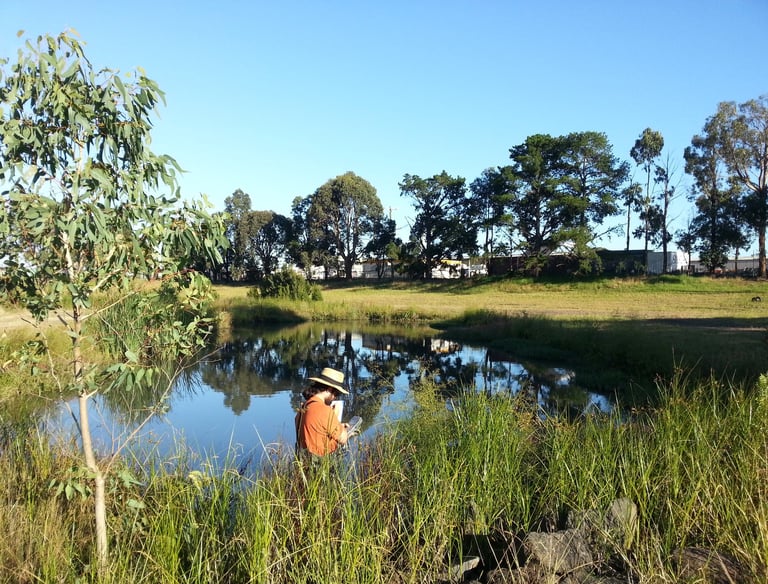
Understanding nitrogen cycling in estuaries
Estuaries are critical environments, acting as the link between terrestrial waters and the ocean. Estuaries receive the integrated contaminant load from a catchment, and it is thus crucial to understand how these contaminants behave within an estuary. Broadly, contaminants may:
Accumulate in the estuary (e.g. in the sediment)
Be removed or converted in the estuary
Pass directly to the ocean
My work establishes the conditions and characteristics of an estuary and its catchment that determines these outcomes, with a particular focus on nitrogen cycling.
I also study the variability of denitrification and nitrous oxide production over a variety of spatial and temporal scales.
As well as understanding the drivers of these fundamental processes, this project informs waterways management and nutrient inventories.
Unexpected redox cycling in sandy sediments
Carbon mineralisation is well understood to progress via a predictable sequence of redox reactions. The "redox cascade" paradigm has persisted for decades, with few amendments.
Our work shows that the redox cascade is bypassed in sandy sediments, with fermentation dominating within minutes of the onset of anoxia.
This project is deciphering the complex metabolism of metabolically flexible microbial communities and the biogeochemical reactions that occur in these dynamic sediments.
Burrowing fauna control benthic nutrient fluxes
In the action of digging and ventilating their burrows, worms and other small animals enhance transport and coupling between water bodies and the sediments below.
Some worms are surprisingly resilient, able to maintain burrow ventilation even under very low oxygen conditions.
This project connects these ideas in a unique and unprecedented way to establish how burrowing fauna control nutrient fluxes, in particular under low-oxygen conditions.
Laboratory experiments observe the metabolism and ventilation behaviour of worms under varied oxygen conditions
Controlled microcosm experiments determine the impact of this behaviour on sediment-water coupling
Computational modelling determines the environmental impact and relevance of this effect
Research Student Opportunities
This is a non-exhaustive list of projects that may be available for potential research students, depending on appropriate skills, experience and funding.
Accurate measurements of fluxes over permeable sediment
Because of the complicated three-dimensional advective transport of water through permeable sediments, many techniques used in cohesive sediments (e.g. benthic chambers) may not be able to faithfully reproduce natural conditions
This project will characterise the drivers of permeable sediment biogeochemistry and develop a statistical or analytical tool for estimating accurate fluxes based on common sampling and observation methods
This project will suit applicants with strong analytical and coding skills, and may also involve some in-situ or laboratory biogeochemistry for validation
Dissolution of carbonate sediments
This project aims to generalise the findings that carbonate reef sediments are dissolving and estimate the rate of dissolution across a range of environments.
This project suits applicants with laboratory and/or GIS and numerical skills. Depending on your skillset, this project would involve microcosm experiments over environmental gradients to determine the drivers and rates of dissolution, GIS analysis of likely dissolution areas, and numerical modelling (coupled hydrodynamic-biogeochemical models).
Remote sensing of greenhouse gas fluxes at small scale
This project will use remote sensing techniques to estimate GHG fluxes from small aquatic systems (e.g. urban lakes). It suits someone with data-handling skills (especially GIS).
My work combines field observations, laboratory microcosm experiments, high-precision analytical techniques and computational modelling to understand complex yet important problems in environmental systems.
You can see my full publication list below at any of the links below.
I am also available to collaborate on water quality and related projects. See below for details